Wednesday, 28 January 2015

An accident at sea: Alfred John Farrant, 6 February 1915


The war memorial in All Saints Church, East Budleigh church

On 6 February, 1915, Petty Officer 1st Class Alfred John Farrant was recorded as having drowned.  He has no known grave, but is listed on East Budleigh’s village memorial and in the parish church of All Saints. He is also remembered on the Plymouth Naval Memorial. 

Petty Officer Farrant was 37 years old and left a widow, Gertrude, whose address was given as 16, Morice Square, Devonport. 

Known to his family as John, as is evident from the village memorial, he was the son of George and Emily Farrant, of East Budleigh;  his father is recorded as a bricklayer.  


HMS Thunderer at anchor at Spithead, in the Solent, off the coast of Hampshire, in 1912. This is photograph Q 21854 from the collections of the Imperial War Museums (collection no. 2107-01)

At the time of his death he was serving on HMS Thunderer, one of the Royal Navy’s most expensive battleships constructed in 1909 as a result of the Admiralty’s call to counter the German naval expansion.


The First Fleet assembles for the King's review on 18 July 1914.  A postcard image described as likely to be an artist's vision

The  vessel was part of the 2nd Battle Squadron consisting of battleships which made up the Royal Navy’s Grand Fleet. No other casualty on board Thunderer was reported on that day, suggesting that John’s death was accidental. Research has shown that he was a gun layer or ‘sight setter’ with the task of helping the ship’s guns to aim at a target. 

Many local men who served with the Royal Navy during the Great War came from a fishing background. This does not seem to have been the case with John Farrant.  

It is possible that he may have been encouraged to go to sea by George Farrant, who was serving with the Coast Guard. George Edward Farrant, born in Littleham in 1867, had been a coastguard officer in the Isle of Wight. He had local connections, being the son of an agricultural labourer, also named George, who was born in around 1844 at Knowle, in East Budleigh parish. Alfred John Farrant’s father was four years younger, being born in around 1848; it seems likely that the two were cousins.   

George Edward Farrant was transferred from the Isle of Wight after 1911, and by 1919 he is listed as the Chief Officer at Budleigh Salterton’s coastguard station on Coastguard Road. 

‘The Great War at Fairlynch’ 2015 exhibition at Budleigh Salterton’s very special museum! Reviews included: “Wonderful display on WW1, informative, bright and relevant. Well done!! 


Tuesday, 20 January 2015

The threat from the deep


Image credit: © IWM


In common with residents of other British coastal towns, Budleigh Salterton people were only too aware of the threat from the Imperial German Navy.  


On the morning of 16 December 1914, the North Sea ports of Hartlepool, West Hartlepool, Whitby and Scarborough were bombarded by the German First High Seas Fleet Scouting Group. 137 people lost their lives and 592 people were wounded.  The above poster uses the incident to try and encourage people to enlist, but the British public and newspapers were also outraged at the Royal Navy for not protecting the towns.


Scarborough and Hartlepool were fortified towns and were considered legitimate targets by the Germans. While Budleigh Salterton did not fall into that category local people were aware of the threat to the many passing convoys from enemy submarines.   Although Germany’s surface fleet failed to achieve many of its objectives its submarine force posed a major threat to the British supply system.


German submarines at Kiel, Schleswig-Holstein, on 17 February 1914. U 21 is at the far right of the first row. The caption in German reads: "Our submarine boats in the harbour" (in German).

Image source: German Federal Archives and Wikipedia


As early as 5 September 1914, the underestimated U-boat had shocked the British public when SM U-21 hit the 3,000-ton British light cruiser HMS Pathfinder with a torpedo off the Firth of Forth on a calm, sunlit day.  Broken in two, Pathfinder instantly began sinking, dragging most of her crew down with her and leaving a massive pall of smoke to mark her grave. The vessel sank so quickly, in fact, there was insufficient time to launch lifeboats. Of a total of 270 personnel on board including two civilian canteen assistants there were just eighteen known survivors.


Convoys, particularly of merchant ships escorted by Navy warships, were indeed a regular sight off the Budleigh coast.  Local resident Jim Gooding, as recorded in the book Budleigh in bygone days, remembered them passing on most days, mainly in the evening,  and was struck by how close to the shore they sailed. “There were times when it was miraculous that they did not run aground.” 


As a member of the Coast Patrol, he recalled that it was his duty to see that no light was visible from the sea because of the danger from enemy submarines.  


The convoys were, as described by William Cowd, another Budleigh  resident, “a most impressive sight.” In his memoirs kept at Fairlynch Museum he recalled being first on the scene when a dozen crew members of a merchant ship arrived on the beach near the present Marine Court flats on Marine Parade. Their ship had been torpedoed and the crew, taking to the life boat had rowed about 12 miles to the shore. Their cries of “Shipwreck Crew” were heard, but William Cowd also heard a warning from his companion: “You be careful, you be careful, it may be enemy Germans who’ll shoot you.”


Such was the fear of enemy submarines, as intense as that of German spies, that one might guess it verged on the paranoid.


“One morning, looking from the windows of ‘Matford’ on Marine Parade I saw the periscope of a submarine in the Bay,” remembered Winifred Hart in another memoir kept at Fairlynch Museum. “The sea was quite calm. It was probably a German one as we had so many convoys of ships passing during the War.”  [Source: Mrs Hart’s Memories of 1914-18, a document in Fairlynch Museum Local History Room, 1980]. 


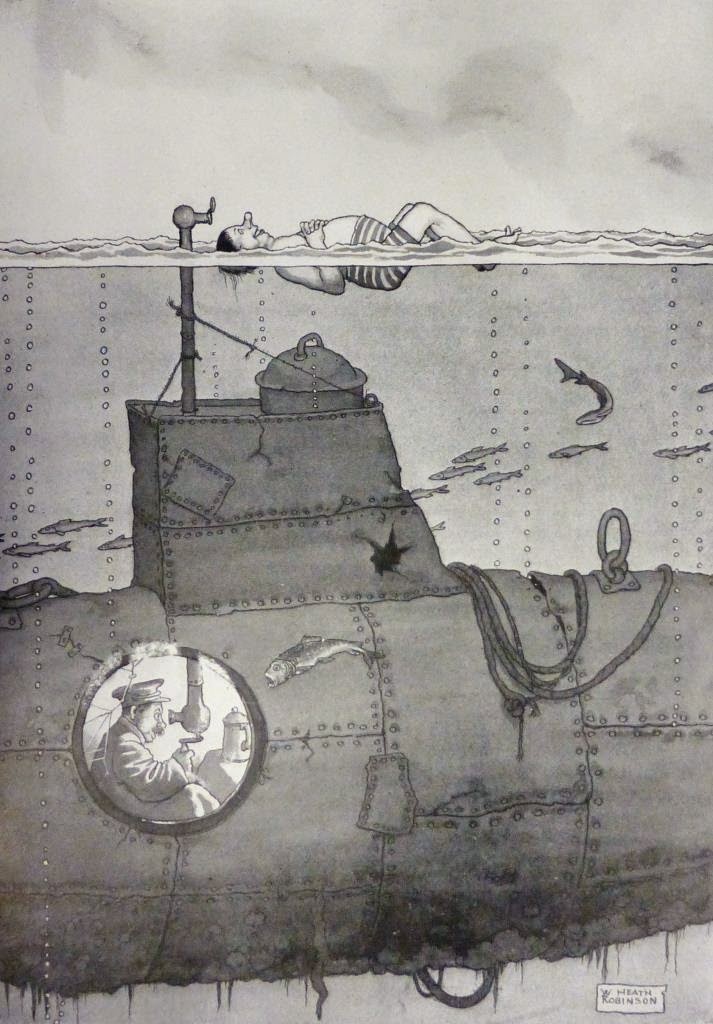
The caption shows a German Periscoper exclaining: "Ach, Himmel! Dot most be der peautiful Ben Nevis of vich ve 'ave 'eard so mooch!"

From the 1915 edition of Frightful War Pictures by W. Heath Robinson published by  Duckworth 

German periscopes were probably 'spotted' as frequently as suspected enemy spies. At least for cartoonists like Heath Robinson they could be a source of humour.  

‘The Great War at Fairlynch’ 2015 exhibition at Budleigh Salterton’s very special museum! Reviews included: “Wonderful display on WW1, informative, bright and relevant. Well done!! 


Friday, 9 January 2015

A Budleigh artist’s “utter disregard of danger”: George Ellis Carpenter and his painting ‘Rainy Day’


There is a fine picture of rain
That I look at again and again.
For the artist, I’ve found,
Was a hero renowned
For a courage you could call insane.


'Rainy Day' is an attractive oil painting of Budleigh Salterton High Street by George Ellis Carpenter.  The painting, part of Fairlynch Museum’s art collection, is interesting as a historical record. A twin picture of Rolle Street in Exmouth was painted by the artist, but its whereabouts are currently unknown.


The antiques shop on the right, currently a barber’s shop, was run by David Thorn, who took it over from his father in the 1960s. The business had originated in the previous decade. A strongroom, one of the features in the antiques shop was a relic from the time when the building had belonged to the Westminster Bank. 

Opposite the antiques shop at No 1 High Street was Milne's, a chemist's shop.  I was told, however, that the painter was criticised for his artistic licence in adding a non-existent pedestrian crossing to this scene of Budleigh. 


Rain is a popular subject for artists. I like the way in which Carpenter has combined the distorting effect of water with the effects of light. He has transformed Budleigh High Street into a floating liquid world; the darker depiction of some of the distant figures - things as well as people -  makes them less important than their reflections in the flooded street, while the rain-soaked far distance envelops buildings in greyness. It’s almost as if the street is turning into a mad and misty torrent, heading westward. 

Yet this seems to be the end of a rainy day. The sun is breaking through from the south, giving colour to the nearer figures and buildings; even the orange globe of the Belisha beacon plays its part in the process.  One of the two girls in the foreground, without an umbrella, is holding out a hand as if to tell us that the rain is stopping. The lighter sky in the west is a hopeful sign.


George Carpenter was very much an amateur painter. Originally from Yarmouth, Suffolk, he served in World War One on the Western Front. He was commissioned as a Lieutenant in the Royal Engineers and gained an MC for exemplary gallantry in January 1918 at the age of 27.


The story of his bravery deserves telling even though he was not born in the Lower Otter Valley. Originally from Yarmouth, Suffolk, he had started out as a Private in the Civil Service Rifles, otherwise known as the 15th (County of London) Battalion, The London Regiment (Prince of Wales's Own Civil Service Rifles).


By January 1915, he  is recorded in the London Gazette of 15 January 1915 [p.495] as being seconded as a Second Lieutenant in The Post Office Rifles, or to give it its full title, the 8th (City of London) Battalion of The London Regiment.


Today, it has been said, the Post Office Rifles are best remembered for their involvement as infantry on the Western Front in the First World War, distinguished by their bravery, tenacity and character in the grim conditions of the trenches.


Two years later, on 26 September 1917, George Carpenter’s appointment as acting Captain with the Royal Engineers was announced in the London Gazette.


Men of R. E. Signals, 1st Corps, burying cable along trench in wooden cases.  © IWM (Q 27152)


His role was in the specialist area of communications on the front line rather than in combat.  As trench warfare came to characterise much of the conflict on the Western Front, the opposing armies relied on traditional techniques of communication such as semaphore and lamps, but also on the widespread use of wires for messaging between the front lines and command HQs.


It’s been estimated that tens of thousands of miles of copper-core cables were laid for both Morse telegraphy and for voice telephony. In many cases, wires were laid on the ground or on low poles, or buried in the ground down to 30 cm deep. Even at that depth they could be destroyed by artillery fire or explosions; a depth of at least 130 cm was needed to afford suitable protection. 


Three men of the Royal Engineers Cable Section carry drums of cable    Image credit: http://worldwar42.blogspot.co.uk


When attacks were planned, brave technicians like George Carpenter were expected to venture out into no-man’s land in order to lay communication lines, risking their lives while facing the threat of snipers and artillery shells.  Only towards the end of the war did wireless communication become more common, with sets being made small enough to be carried by troops.


On 8 January 1918, the London Gazette announced the award of a Military Cross to acting Captain George Ellis Carpenter.  

 The citation read as follows:    

“For conspicuous gallantry and devotion to duty on numerous occasions. He has continually shown absolute fearlessness and the greatest ability in the execution of his work, on at least two occasions going forward under heavy shell fire and making a personal and successful reconnaissance for the laying out of lines which were urgently needed. His splendid personal example and utter disregard of danger have on all occasions set a very high standard to the linesmen in his company.”


Having moved to Budleigh as Manager of the town's Gas Works he took up art as a hobby and was a founder member of the Exmouth Art Group, acting as its part-time Secretary.


George Carpenter, standing, third from the left, with members of Budleigh Salterton Drama Club. 
Image from Fairlynch Museum archives  

He also became involved in amateur dramatics, particularly with pantomime. He took the occasional acting role. In 1930, one of a cast of 14, he played the part of Horace, the Court Physician, in a production of The Sleeping Beauty in the Public Hall.  A document in Fairlynch Museum dated December 1937 lists him as one of the founder members of Budleigh Salterton Drama Club. He was also responsible for the lighting in many productions, and his scenery painting skills were much valued.


He obviously demanded high standards. Friend of Fairlynch Museum Anita Jennings recalled an incident involving fellow Drama Club member Ron Cox, who told her the story of how he was apprenticed to George Carpenter.


“For one play he was allowed to paint the scenery,” she said. “Less experienced than the master, but keen to make his mark Ron worked at it for hours.... only to discover that at some unearthly hour George Carpenter had been to the Club and painted over all of Ron's work.” 

‘The Great War at Fairlynch’ 2015 exhibition at Budleigh Salterton’s very special museum! Reviews included: “Wonderful display on WW1, informative, bright and relevant. Well done!! 


Friday, 19 December 2014

Eating rats and lice?


Ratting: The New Sport in the Trenches. This image shows Canadian troops engaged in a rat hunt at Ploegsteert Wood near Ypres during March 1916.  Image credit:  http://www.rentokil.co.uk


Much has been written about soldiers’ food during the Great War. It seems that troops were fed better in 1914 than by the end of the conflict. Meat rations were steadily reduced and by 1916 flour was so scarce that bread was made from dried ground turnips.   


 A canned broth containing sliced turnips, carrots and potatoes, made by the Aberdeen-based Maconochie Company and used as a ration in the field was generally detested.


British troops receiving dinner rations from field kitchens in the Ancre area of the Somme, 1916. Hot food was not supplied to front line soldiers until late 1915 and even then was by no means a regular occurrence. Photo from the collection of the Imperial War Museums, © IWM, Q 1582  


Inevitably the food was cold by the time that it reached men in the trenches. No doubt in many cases it did not reach them for days when the lines of communication and supply were disrupted by enemy shelling.  


Private Joseph Marker came from Budleigh Salterton. He enlisted at Exeter on 10 December 1915 and joined the Devonshire Regiment.  His remarkable story is told in detail in ‘The Great War at Fairlynch’ exhibition.  Image credit: Celia Marker  


Occasionally, the question has arisen as to whether famished British soldiers were reduced to eating rats. 

This must surely have been a rare occurrence, but one piece of testimony worth noting comes from Celia Marker, whose grandfather joined the Devonshire Regiment. "When I was a little girl he mentioned eating rats whilst he was serving in France!" she recalled on the   Wartime Memories Project website


It is true that rat infestation was widespread as a result of the unhygienic environment in the trenches, and the rats were often larger than usual.  But it was known that rats were in the habit of feeding on dead or even wounded bodies, making them unlikely to tempt even the hungriest man. 
   
Lice infestation was equally common, and was a frequent cause of an infectious disease known as trench fever.  George Watson, in his memoirs kept at Fairlynch Museum, described his return home on leave, his clothing “wet and lousy, full of lice and their eggs” much to the horror of his mother. “The lice were killed by crushing between the thumb nails.  Even when the clothing had been washed the lice grew again from the eggs still in the clothing.”

Black humour was often found to be the only way of coping with the miseries of trench life.  Even the lice could raise a smile.  “One  chap  saw  the  Quartermaster  Sergeant,” recalled George Watson. ‘Can I  'ave a new shirt  Quarters?’  he asked.  ‘What's wrong  with  your  other  one?’ asked  Q.  ‘There's eggs all t'way up t'seams,’  the man replied. ‘Well  go and  get a collop o' bacon and 'ave a good do’, the Quartermaster joked.”


‘The Great War at Fairlynch’ 2015 exhibition at Budleigh Salterton’s very special museum! Reviews included: “Wonderful display on WW1, informative, bright and relevant. Well done!! 


An army doctor’s memories: the Christmas Truce of 1914


Budleigh Salterton solicitor Patrick Langrishe, pictured above, kindly showed me extracts from a diary kept  by his grandfather, an army doctor who served on the Western Front.  The entries for Christmas Day and Boxing Day 1914 make fascinating reading


We’re further into December. The prospect of an Anglo-German football match in 2014 between the clubs of Budleigh Salterton and Betheln is receding further into the distance.


Yet I keep thinking about the remarkable events of the Christmas truce just over a century ago, following on from what I wrote at http://fairlynchgreatwar.blogspot.co.uk/2014/12/chatting-with-enemy.html


I was reminded of that bizarre episode in the Great War after reading Rose Wild’s Feedback column in The Times of 14 December. It mentions the “slightly surreal” tone of letters from serving soldiers sent to their families and forwarded for publication in the newspaper. One of them was from a piper in the Scots Guards.


“One German gave our officer a letter to post to a lady he knows in Essex,” he wrote. “I must say some of them are very nice fellows, and did not show any hatred, which makes me think they are forced to fight. I wrote you a letter telling you we made a bayonet attack. I wonder if you got it. We lost a few men. The Germans helped us to bury them on Christmas Day.”  


I’d started reading the Feedback column having spotted Rose Wild’s mention of Budleigh solicitor Patrick Langrishe, a partner with Devon law firm Gilbert Stephens.


Mr Langrishe has some equally remarkable stories to tell, based on extracts from the diary kept by his grandfather, Lieutenant-Colonel John du Plessis Langrishe DSO, an officer serving as an army doctor with the RAMC.  


This personal photograph was taken by Robert Cotton Money on 7 December 1914.  It shows the crew of an 18-pounder Field Gun in a gun emplacement on the Armentières sector of the front line, in France.
Photo credit: Imperial War Museum   Q51542


The Battle of Armentières had been fought by German and Franco-British forces in northern France from 13 October to 2 November 1914, during reciprocal attempts by the opposing armies to envelop the northern flank of their opponent. It was part of what been called the Race to the Sea, which I mention elsewhere


There is a detailed account of encounters on Christmas Day between men of the Queens Westminster Rifles and those of the 107th Saxon Regiment.  


The 25 December was, the diary records,  “a really  peaceful day.”  After a church service in the morning, followed by lunch, the young officer went for a   walk with a veterinary officer, returning by Armentières.


He wrote as follows about the unusual Christmas Day events: “The Saxons (107th) came out & talked to our men of Q.W.R., had a sing-song & a game of football which the Saxons won 3-2!  They even sang "God save the King"!! & gave our men some wine in which to drink his health.  Some came into our trenches, a few  remaining, saying they preferred to go to England!” 


It was not just the other ranks involved with this fraternisation with the enemy. The diary records that the Saxons’ Colonel and Adjutant “also came out & chatted.”   

The truce was by no means universally observed. Things were “very  different” on the south of Rue du Bac, to the west of Armentières, where the Germans “fired on the Leicesters & refused to have any truck with them.”


According to Colonel Langrishe’s diary the truce lasted only until the following morning of Boxing Day. “Lovely bright frosty morning, clouding over later,” he wrote. “After lunch snow, turning to a thaw & rain in the evening. C. Atkin  joined me at 10 o’c & after the sick went round "egg farmers", returning to his chateau where I showed him positions on the map. Stayed in after lunch on  account of weather. Bath after tea. Heard that a Saxon officer came across to  our trenches at 11 a.m. & said that he was sorry but they had orders to  resume hostilities at once. Germans have been stuffed with all sorts of yarns about invasion of England, & bombardment of London.  In their last attack on Rue du Bois on Oct. 28th the  l07th Saxon Regt. lost all  their officers & were   fired into by  their own artillery!”


Happier days: the photo shows Colonel Langrishe beside the River Liffey, during his time at Trinity College Dublin.  Known to friends and family as Jack,  he captained the University Boat Club in 1906.    Image credit: www.tcdlife.ie


Colonel Langrishe was not a Devon man but the account of his wartime experience will fascinate anyone with an interest in the human side of the Great War.

His eleven handwritten diaries, consisting in total of 482 pages, are kept at the Imperial War Museum.  They were written between 8 September 1914 and 23 March 1919, during his service with the Royal Army Medical Corps in multiple appointments. 

He was Medical Officer of the 38th Brigade RFA (6th Division) from August 1914 to January 1915; to 16th Field Ambulance (16th Infantry Brigade, 6th Division) between January and November 1915; to the staff of the ADMS (14th Division) between November 1915 and June 1916; and was finally commander of the 12th Field Ambulance (12th Infantry Brigade, 4th Division) between June 1916 and April 1919.

The diaries describe his experiences on the Western Front, including his inspection duties of brigade field ambulances, casualty clearing stations, camp huts, baths and sanitation, as well as his personal experiences during the Somme ‘push’ of 1916 in handling the wounded and the dead on the battlefields.  


Maybe some friendly Saxon from Betheln will read my online scribblings about the Great War Christmas Truce, and get in touch with their own positive WW1 stories. 

That would be a cheering thing to do in this traditional season of peace and goodwill, when an awfully large part of the world seems to be locked in stupid conflict. 

‘The Great War at Fairlynch’ 2015 exhibition at Budleigh Salterton’s very special museum! Reviews included: “Wonderful display on WW1, informative, bright and relevant. Well done!!