Showing posts with label Devon. Show all posts

Thursday, 18 February 2016

A most cheerful company commander: Captain Ernest Cecil Blencowe Blencowe, 16 February 1916


Captain Ernest Cecil Blencowe Blencowe’s name is recorded on both the Budleigh Salterton Roll of Honour in St Peter’s Church and on the town’s War memorial.

Born on 10 March 1881 in Derby according to Fairlynch Museum researcher Sheila Jelley, Ernest was the son of Ernest Gottwaltz  and his wife Sarah Harriet Ellen née Smee. The brewery and wine and spirit business of Gottwaltz and Lind, of Paignton, in which a certain Ernest Gottwaltz had been a partner, was dissolved on 24 June 1890 according to the London Gazette. However the family were sufficiently well off for young Ernest to be sent to Saugeen School, ‘A Preparatory School for Boys for the Public Schools and the Navy,’ located in Derby Road, Bournemouth. The school has since closed, demolished in 1935 to be replaced by houses.


A page from Sherborne School's WW1 Memorial Book 
Image credit: http://www.sherborne.org.uk 

In May 1896 he was registered as attending Sherborne School in Dorset, his family’s address being recorded as Culworth, a large Victorian house on Northdown Road in Bideford.  At Sherborne he was attached to the boarding house of The Green. 

He left the School in August 1899 and by 1901 was living in London and had changed his name. In 1910, according to Fairlynch Museum research, he married Ellen Mary Blanche Edwards. It seems, according to his will that he was living at Moose Jaw, a city in Saskatchewan, Canada, but he was also registered at an address in Bayswater, London. However by 1913 he and Ellen had moved back to Devon. Their daughter was born in Budleigh Salterton, where they seem to have been living at ‘Westcott’, 5 Links Road, known at that time as Golf Road.


A Dorsetshire Regiment cap badge

Ernest had volunteered to join the Dorsetshire Regiment, serving with the 6th (Service) Battalion. The Battalion was shipped to Boulogne in France on 14 July 1915 as part of 50th Brigade in the 17th (Northern) Division. It was engaged in various actions on the Western Front including, in 1915, holding front lines in the southern area of the Ypres Salient.

Ernest was killed in action on The Bluff, near Hill 60, Ypres Salient, on 16 February 1916, whilst serving with ‘A’ Company of the 6th Battalion. The area in which he was killed was the scene of fierce fighting throughout the Great War.  It was taken from the French by German forces on 10 December 1914, recaptured by the British on 17 April 1915, retaken by the Germans on 5 May 1916, ceded back to the British on 7 June 1917 (the first day of the Messines offensive), taken once again by the Germans in April 1918 (during the great Spring push) and finally captured by the British on 28 September 1918.
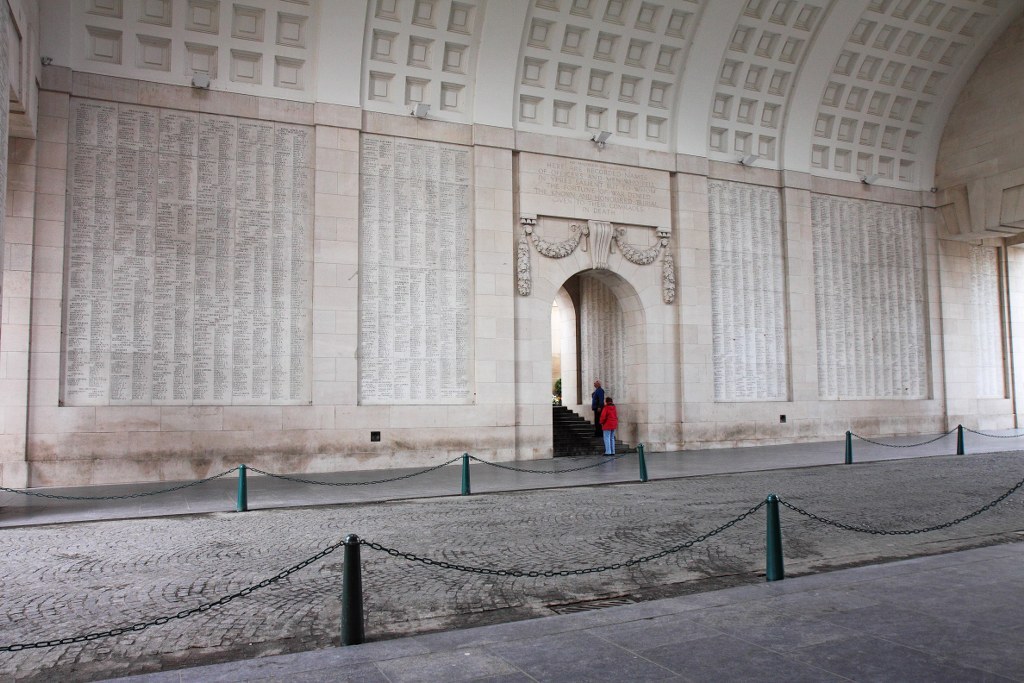


The Regimental History described Captain Blencowe as ‘A most cheerful company commander of “A”. It noted also that he had changed his name from Blencowe-Gottwaltz to Blencowe-Blencowe, ‘as a precaution against possible capture’. He was posthumously Mentioned in Despatches, as recorded in the London Gazette of 15 June 1916. His name appears on Panel 37 of the Menin Gate Ypres Memorial in Belgium, pictured above.

On 13 June 1916, Ellen suffered a second blow when her father, the Reverend Nathaniel Edwards, died at their home on Links Road, four months after losing her husband.




‘The Great War at Fairlynch’ 2015 exhibition at Budleigh Salterton’s very special museum! Reviews included: 'Wonderful display on WW1, informative, bright and relevant. Well done!!' 


Wednesday, 13 May 2015

The first of two brothers to fall: Elphinstone Aplin, 13 May 1915


John and Francis Pepys 
Image credit: Charterhouse for Francis Pepys 

John and Francis Pepys were two brothers from Knowle, killed in action in 1914, as mentioned elsewhere  on this blog. Their heartbroken father died in 1920. 

Along with the 163 people linked to the Lower Otter Valley who lost their lives on active service during the First World War, many families sadly had to deal with the loss of more than one family member.

Finding at least half a dozen families from the Lower Otter Valley alone who lost two or even three sons between 1914 and 1918 is one of many  sobering indications of the scale of human suffering in the Great War.  Cruelly, some were even reported killed on the same day.


 Elphinstone Aplin, killed in action in May 1915
Image credit: Heather Aplin

Lieutenant Elphinstone D'Oyly Aplin was the son of Lieutenant Colonel Hugh Aplin and his wife Annie, of Links Road, Budleigh Salterton. He was born in 1892 at Upnor Castle, Rochester, but in 1901 according to the 1901 census, was living in West Teignmouth, Devon, as his father was working for the Royal Naval Ordnance Depot at St Budeaux, Plymouth.  Educated at Kelly College, Tavistock, he later moved to King's School, Rochester, before entering the Army in February 1913. He was promoted Lieutenant  in October 1914, joining the 2nd Battalion of the Gloucestershire Regiment and fighting in Flanders.  


The remains of trenches at Sanctuary Wood
©  Mo Sandford FRPS 2014
More of Mo Sandford's remarkable photos of World War I battlefields can be seen here

A few miles east of Ypres, in the area known as Sanctuary Wood, he and his men found themselves trapped by a barrage of enemy shell and rifle fire.  While attempting to lead them to safety he was severely wounded and died on 13 May 1915. 


Bailleul Communal Cemetery   
Image credit: Commonwealth War Graves Commission http://www.cwgc.org

Elphinstone Aplin is buried in Bailleul Communal Cemetery, in the Nord district of Northern France.


Eric Aplin, killed in action in March 1918
Image credit: Heather Aplin

In the final year of the war, Hugh and Annie Aplin received a second blow. Their son Eric, like his brother Elphinstone, had attended King's School, Rochester before joining the 2nd Battalion, the Worcestershire Regiment. He was wounded at the Battle of Loos in September 1915, when gas was first used by the British, and was wounded again in November 1916 during the later stages of the Battle of the Somme. By 1918, now promoted to Captain, he was involved in the heavy fighting which had been taking place around the Belgian village of Passchendaele from July of the previous year.


Nine Elms Cemetery
Image credit: Commonwealth War Graves Commission
www.cwgc.org

Eric Aplin was mortally wounded on Passchendaele Ridge while leading an offensive patrol and died on 11 March. He is buried in Nine Elms Cemetery, shown above, west of the town of Poperinge in Belgium. Both brothers are remembered on the brass plaque in St Peter’s Church, Budleigh Salterton, and on the town’s war memorial.

‘The Great War at Fairlynch’ 2015 exhibition at Budleigh Salterton’s very special museum! Reviews included: “Wonderful display on WW1, informative, bright and relevant. Well done!! 


Friday, 24 April 2015

WW1 tragedy of Budleigh Coast Guard remembered


 Pam Ashcroft with the WW1 plaques that she is lending to Fairlynch Museum  

 Precious and poignant items relating to the 1914-18 world conflict continue to be offered for display as part of ‘The Great War at Fairlynch’ in Budleigh Salterton’s museum.

The latest mementos to take their place in the exhibition come from Pam Ashcroft, great-niece of Ordinary Seaman Francis Thomas Veal.


The son of Francis and Elizabeth Veal of Budleigh Salterton’s Coast Guard Station, he lost his life, aged just 18, along with 800 other crew members in the HMS Vanguard explosion on 9 July, 1917.  His name is on the Budleigh War Memorial, opposite his then family home. 

It seems that the prime cause of the explosion is not known, but the most likely scenario is thought to be a fire in a compartment adjacent to a magazine which caused the cordite to explode.  Smoke detectors and automatic sprinkler systems were not fitted in HM ships of this date.


The commemorative plaque and scroll are treasured reminders to Francis Veal’s family of the son that they lost in the Great War

Budleigh-born Pam, who lives in Kilkenny, last visited the town some 15 years ago. The granddaughter of Bill and Kath Veal, of Boyne Road, she made the journey to the Museum on 10 April, coming all the way from Ireland to bring a commemorative plaque and a scroll, having heard about its ‘Great War’ display.

“They’re so special for me and my family, and it’s a privilege for us to have them,” she said. “We’re delighted to lend them to Fairlynch so that other people can see them in this wonderful exhibition.” 

If you can help the museum with similar WW1 items or stories please call Sheila on 01395 443197 or email mail@devonremembers.co.uk  

‘The Great War at Fairlynch’ 2015 exhibition at Budleigh Salterton’s very special museum! Reviews included: “Wonderful display on WW1, informative, bright and relevant. Well done!!  


Friday, 19 December 2014

Eating rats and lice?


Ratting: The New Sport in the Trenches. This image shows Canadian troops engaged in a rat hunt at Ploegsteert Wood near Ypres during March 1916.  Image credit:  http://www.rentokil.co.uk


Much has been written about soldiers’ food during the Great War. It seems that troops were fed better in 1914 than by the end of the conflict. Meat rations were steadily reduced and by 1916 flour was so scarce that bread was made from dried ground turnips.   


 A canned broth containing sliced turnips, carrots and potatoes, made by the Aberdeen-based Maconochie Company and used as a ration in the field was generally detested.


British troops receiving dinner rations from field kitchens in the Ancre area of the Somme, 1916. Hot food was not supplied to front line soldiers until late 1915 and even then was by no means a regular occurrence. Photo from the collection of the Imperial War Museums, © IWM, Q 1582  


Inevitably the food was cold by the time that it reached men in the trenches. No doubt in many cases it did not reach them for days when the lines of communication and supply were disrupted by enemy shelling.  


Private Joseph Marker came from Budleigh Salterton. He enlisted at Exeter on 10 December 1915 and joined the Devonshire Regiment.  His remarkable story is told in detail in ‘The Great War at Fairlynch’ exhibition.  Image credit: Celia Marker  


Occasionally, the question has arisen as to whether famished British soldiers were reduced to eating rats. 

This must surely have been a rare occurrence, but one piece of testimony worth noting comes from Celia Marker, whose grandfather joined the Devonshire Regiment. "When I was a little girl he mentioned eating rats whilst he was serving in France!" she recalled on the   Wartime Memories Project website


It is true that rat infestation was widespread as a result of the unhygienic environment in the trenches, and the rats were often larger than usual.  But it was known that rats were in the habit of feeding on dead or even wounded bodies, making them unlikely to tempt even the hungriest man. 
   
Lice infestation was equally common, and was a frequent cause of an infectious disease known as trench fever.  George Watson, in his memoirs kept at Fairlynch Museum, described his return home on leave, his clothing “wet and lousy, full of lice and their eggs” much to the horror of his mother. “The lice were killed by crushing between the thumb nails.  Even when the clothing had been washed the lice grew again from the eggs still in the clothing.”

Black humour was often found to be the only way of coping with the miseries of trench life.  Even the lice could raise a smile.  “One  chap  saw  the  Quartermaster  Sergeant,” recalled George Watson. ‘Can I  'ave a new shirt  Quarters?’  he asked.  ‘What's wrong  with  your  other  one?’ asked  Q.  ‘There's eggs all t'way up t'seams,’  the man replied. ‘Well  go and  get a collop o' bacon and 'ave a good do’, the Quartermaster joked.”


‘The Great War at Fairlynch’ 2015 exhibition at Budleigh Salterton’s very special museum! Reviews included: “Wonderful display on WW1, informative, bright and relevant. Well done!!