Showing posts with label Budleigh. Show all posts

Thursday, 18 February 2016

A most cheerful company commander: Captain Ernest Cecil Blencowe Blencowe, 16 February 1916


Captain Ernest Cecil Blencowe Blencowe’s name is recorded on both the Budleigh Salterton Roll of Honour in St Peter’s Church and on the town’s War memorial.

Born on 10 March 1881 in Derby according to Fairlynch Museum researcher Sheila Jelley, Ernest was the son of Ernest Gottwaltz  and his wife Sarah Harriet Ellen née Smee. The brewery and wine and spirit business of Gottwaltz and Lind, of Paignton, in which a certain Ernest Gottwaltz had been a partner, was dissolved on 24 June 1890 according to the London Gazette. However the family were sufficiently well off for young Ernest to be sent to Saugeen School, ‘A Preparatory School for Boys for the Public Schools and the Navy,’ located in Derby Road, Bournemouth. The school has since closed, demolished in 1935 to be replaced by houses.


A page from Sherborne School's WW1 Memorial Book 
Image credit: http://www.sherborne.org.uk 

In May 1896 he was registered as attending Sherborne School in Dorset, his family’s address being recorded as Culworth, a large Victorian house on Northdown Road in Bideford.  At Sherborne he was attached to the boarding house of The Green. 

He left the School in August 1899 and by 1901 was living in London and had changed his name. In 1910, according to Fairlynch Museum research, he married Ellen Mary Blanche Edwards. It seems, according to his will that he was living at Moose Jaw, a city in Saskatchewan, Canada, but he was also registered at an address in Bayswater, London. However by 1913 he and Ellen had moved back to Devon. Their daughter was born in Budleigh Salterton, where they seem to have been living at ‘Westcott’, 5 Links Road, known at that time as Golf Road.


A Dorsetshire Regiment cap badge

Ernest had volunteered to join the Dorsetshire Regiment, serving with the 6th (Service) Battalion. The Battalion was shipped to Boulogne in France on 14 July 1915 as part of 50th Brigade in the 17th (Northern) Division. It was engaged in various actions on the Western Front including, in 1915, holding front lines in the southern area of the Ypres Salient.

Ernest was killed in action on The Bluff, near Hill 60, Ypres Salient, on 16 February 1916, whilst serving with ‘A’ Company of the 6th Battalion. The area in which he was killed was the scene of fierce fighting throughout the Great War.  It was taken from the French by German forces on 10 December 1914, recaptured by the British on 17 April 1915, retaken by the Germans on 5 May 1916, ceded back to the British on 7 June 1917 (the first day of the Messines offensive), taken once again by the Germans in April 1918 (during the great Spring push) and finally captured by the British on 28 September 1918.


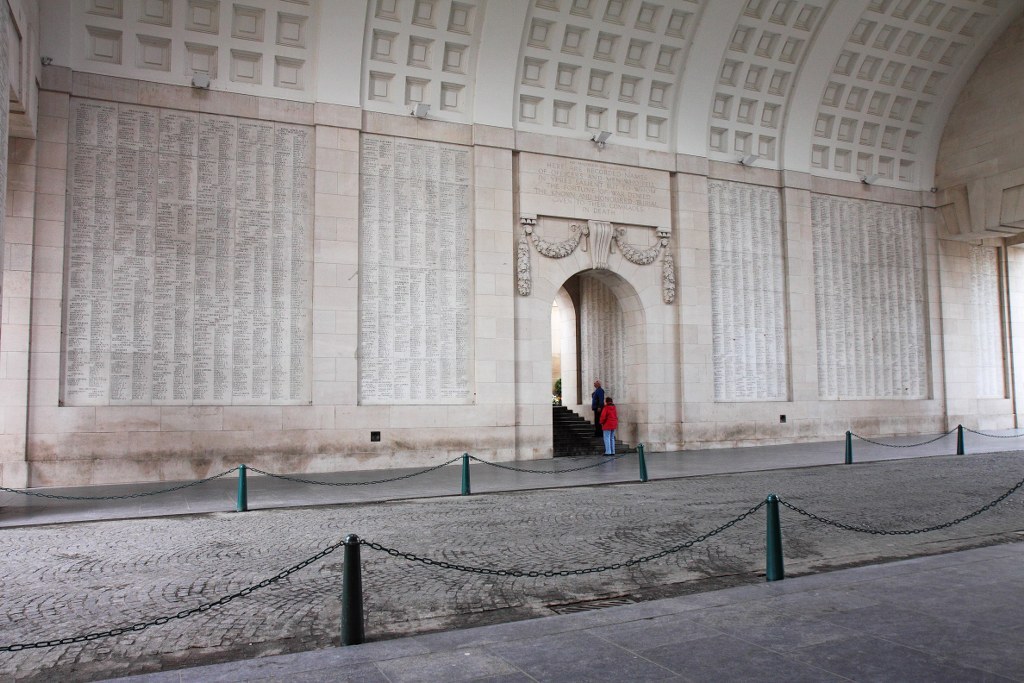
The Regimental History described Captain Blencowe as ‘A most cheerful company commander of “A”. It noted also that he had changed his name from Blencowe-Gottwaltz to Blencowe-Blencowe, ‘as a precaution against possible capture’. He was posthumously Mentioned in Despatches, as recorded in the London Gazette of 15 June 1916. His name appears on Panel 37 of the Menin Gate Ypres Memorial in Belgium, pictured above.

On 13 June 1916, Ellen suffered a second blow when her father, the Reverend Nathaniel Edwards, died at their home on Links Road, four months after losing her husband.


‘The Great War at Fairlynch’ 2015 exhibition at Budleigh Salterton’s very special museum! Reviews included: 'Wonderful display on WW1, informative, bright and relevant. Well done!!' 


Friday, 6 November 2015

Behind the name on the Croquet Cup


Sir (Ernest) Leslie Gossage in October 1941
© National Portrait Gallery, London   
Artist: Bassano Ltd

Air Marshal Sir Ernest Leslie Gossage KCB, CVO, DSO, MC, was one of the most highly decorated RAF officers to have fought in the Great War. He was not a Budleigh resident, but his family name is so well known in the town that his wartime service deserves a mention.


The Gossage family originated from Widnes in Cheshire, where William Gossage (1799-1877) opened his soap factory in 1850. His son Frederick Herbert (1833-1907) carried on the business successfully, living at a house named Winwood in Much Woolton,  an affluent suburb of Liverpool.

The name of Winwood recurs several times in the Gossage family records. It was borne by two of his sons, including William Winwood Gossage (1862-1934). Mayor of Widnes in 1901-02,  he was described as a soap manufacturer, as was his younger brother Ernest Frederick Gossage (1863-1933).

Ernest Frederick Gossage moved to Budleigh Salterton at some stage, living at a house called Homeland in 1919 according to a local town directory. However he either moved to another house or, more likely, renamed it in accordance with the family tradition. It was at Winwood, on Cricketfield Lane, that he died on 25 February 1933.

Their son Ernest Leslie Gossage (1891-1949) was born at Toxteth Park, Liverpool, on 3 February 1891.  He was educated at Rugby School and Trinity College, Cambridge.

On 19 July, 1912,  he was appointed as Second Lieutenant of the Royal Field Artillery, having joined the RFA Reserve while still at University.  On 12 May, 1915, he was listed as a Flying Officer with the Royal Flying Corps (RFC), the air arm of the British Army. The term was originally used in RFC as a flying appointment for junior officers, not a rank.

At the start of the war, the role of the RFC consisted of artillery co-operation and photographic reconnaissance.  Commanded by Brigadier-General Sir David Henderson, it consisted of five squadrons – one observation balloon squadron (RFC No 1 Squadron) and four aeroplane squadrons. These were first used for aerial spotting on 13 September 1914, but only became efficient when they perfected the use of wireless communication at Aubers Ridge on 9 May 1915. Aerial photography was attempted during 1914, but again only became effective the next year. By 1918, photographic images could be taken from 15,000 feet, and interpreted by over 3,000 personnel.

Gossage was assigned to No. 6 Squadron as a pilot. Formed at Farnborough on 31 January 1914, the squadron had arrived in France in August of that year.

By 5 September 1915 Gossage had reached the rank of Captain and had become a Flight Commander in No. 6 Squadron.

Following a promotion to Major in 1916, he was given command of No. 56 Squadron, described as “one of the most famous fighter squadrons of the Royal Flying Corps and early RAF.”


Later in the same year he took command of No. 8 Squadron. Operating from airfields near Saint-Omer, the squadron was initially used for bombing and long-range reconnaissance, carrying out flights of up to 100 miles (160 km) behind the front lines. It was equipped with a mixture of aircraft, including the Royal Aircraft Factory BE8 and the Bristol Scout, while it also evaluated the prototype Royal Aircraft Factory BE9, pictured above, a modified BE2 that carried the observer/gunner in a nacelle ahead of the aircraft's propeller.

The opinion of those testing the BE9 was generally negative, with Major Hugh Dowding, at the time commander of 16 Squadron, stating that it was "...an extremely dangerous machine from the passenger's point of view”,  while Hugh, later Viscount, Trenchard, head of the RFC in France said that "this type of machine cannot be recommended.” It was sent back to the United Kingdom early in 1916.

In February 1916 No. 8 Squadron moved to Bellevue and specialised in the Corps Reconnaissance role, carrying out contact patrols and artillery spotting in close co-operation with the army. The squadron flew in support of the Battle of the Somme in the summer of 1916 and the Battle of Arras in April–May 1917. 

In 1916, Gossage was awarded the Military Cross for his service with the RFC. The citation, dated 30 March, referred to his  “consistent good and zealous work under bad weather conditions, both on patrol and when co-operating with the artillery in operations resulting in the capture of the enemy's position.” 

The following year, he was promoted to Lieutenant Colonel and took command of the Royal Flying Corps' 1st Wing.  When the Royal Air Force was founded on 1 April 1918 Gossage was appointed as a Staff officer in the Directorate of Operations and Intelligence.

After the War he became Officer Commanding the School of Army Co-operation before moving on to be Deputy Director of Staff Duties at the Air Ministry in 1928.  He was appointed Air Attaché in Berlin in 1930, Senior Air Staff Officer at Headquarters Air Defence of Great Britain and Senior Air Staff Officer at Headquarters RAF Iraq Command in 1934. He went on to be Air Officer Commanding British Forces Aden in 1935 and Air Officer Commanding No. 11 Group in 1936.


Air Marshal Gossage, fourth from left, as Air Member for Personnel, in session with the Air Council during World War II

He served in World War II as Inspector-General of the RAF, as Air Member for Personnel and then as Air Officer Commanding-in-Chief at RAF Balloon Command.

 Following his retirement from regular service with the Royal Air Force, Gossage agreed to be re-employed to assume the role of Commandant Air Cadets after the retirement of Air Commodore John Adrian Chamier. He served in this role until he stepped down in 1946.  He died three years later in Sussex, aged 58.

Although the family background was commercial rather than military, there were links to the armed forces.  William Winwood Gossage is recorded as the Honorary Colonel of the 3rd West Lancashire Brigade of the Royal Field Artillery.


A record of Cambridge University alumni edited by John Venn notes that his brother Ernest Frederick Gossage was described as ‘Lieut.Col.’ in his Times obituary of 27 February 1833 [sic] and in Who’s Who.  The Budleigh Salterton Members Challenge Cup Gossage Cup, which he presented to Budleigh Salterton Croquet Club in 1925, eight years before his death, also attributes this rank to him.   Venn observes that he was not recorded as such in Army Lists. However researcher Richard Daglish has been investigating the Gossage family as part of his study of a local Territorial artillery unit in which several family members served with distinction. Thanks are due to him for pointing out that Ernest Frederick Gossage appears in the London Gazette twice with that rank, one of them as Major, Hon. Lt.Col. (Email 30 October 2018.)

Records of the Budleigh Salterton Croquet Club in the 1970 issue control sheet make mention of a Major Gossage in 1947 with reference to the Gossage Cup. This is likely to have been Major Terence Leslie Gossage MBE (1918-1999), son of the Air Marshal and a Major in the King's Own Yorkshire Light Infantry.


‘The Great War at Fairlynch’ 2015 exhibition at Budleigh Salterton’s very special museum! Reviews included: “Wonderful display on WW1, informative, bright and relevant. Well done!! 

Tuesday, 6 October 2015

The blacksmith’s son from Newton Poppleford: Alfred Thomas Pring, 8 October 1915


British infantry advancing at the Battle of Loos 25 September 1915.  It was the first time that the British used poison gas. In places, the gas was blown back onto British trenches. Due to the inefficiency of contemporary gas masks, many soldiers removed them as they could not see through the fogged-up eyepieces or could barely breathe with them on, which led to some soldiers being affected by the gas as it blew back.

Thousands of wounded men from both sides would die following the bloody battle of Loos on 25 September. 

Private Alfred Thomas Pring was one of the many casualties. Aged only 17, he was one of five children born to William and Emily Pring, of Station Road in Newton Poppleford.  His father, one of the village blacksmiths, had died in 1907, leaving his mother Emily (nee Selleck) to run the smithy business. 

In the 1911 Census she is shown as living with her three children and being the owner of a blacksmith’s business employing 52- year-old Samuel Holmes as a “blacksmith’s servant” and with her eldest son (also called William) as a “student blacksmith” at the age of 14.

Like so many of his schoolboy friends, Alfred joined the Devonshire Regiment, 8th Battalion, in Exeter. On 8 October 1915, less than a year after enlisting, he died of his wounds, having been carried from the battlefield in Flanders.


Newton Poppleford war memorial outside St Luke’s Church

Alfred Pring is buried in France, in Boulogne’s Eastern Cemetery, and is remembered on the war memorial in Newton Poppleford.   


His story is told by Newton Poppleford resident John Hagger at http://www.roll-of honour.com/Devon/NewtonPoppleford.html

‘The Great War at Fairlynch’ 2015 exhibition at Budleigh Salterton’s very special museum! Reviews included: “Wonderful display on WW1, informative, bright and relevant. Well done!!






Tuesday, 15 September 2015

A New Zealander at Gallipoli: Gunner Stephen John Prew, 15 Sept 1915


Stephen Prew and his family at their home Well Cottage, Prew's Hill, Knowle.  Front row (l-r): Louie, William T. and Harriet (parents), Reg; 2nd row (l-r) Edward, Emma; 
3rd row (l-r) William (served in the Royal Field Artillery), Stephen, Arthur, Alice, Albert, Florrie, Walter
Image credit: Fairlynch Museum 


Gunner Stephen John Prew was among those Gallipoli casualties with links to the Lower Otter Valley who had emigrated from Britain to overseas Commonwealth territories.  


The New Zealand Field Artillery badge 

Born in 1893 at Upton Pyne, a few miles north-west of Exeter, he was the son of William Thomas and Harriet Prew. His parents later moved to Well Cottage, Knowle, in East Budleigh parish, and in 1911 he is recorded as living with them and working as an assistant grocer.  

When war broke out he and his brother Albert were living in New Zealand,  Stephen seemingly at Hamilton in the Waikato region of North Island as this was recorded as his enlistment address. 

He was unmarried. Albert was listed as his next of kin, living care of a Mrs Hain in Otahuhu, a suburb of Auckland in the North Island. Like other local men such as Tristram Copplestone Palmer and Reginald Cowd, they had hoped for a better life in that country. New Zealand’s economy had improved by the 1900s and in 1904 assisted migration was restored, making the country an attractive proposition for new immigrants.  


A typical embarkation scene in Wellington as troops prepare to leave for the Great War. Courtesy of Archives New Zealand (Archives Ref: AAME 8106, 11/17/3, R20939655) Source: http://ww100.govt.nz/the-new-zealand-expeditionary-force-sets-forth

On 6 August 1914, shortly after the First World War broke out, Britain accepted New Zealand’s offer of an expeditionary force of approximately 8000 men. Stephen Prew was one of those who volunteered. He embarked on either the troopship Arawa or its companion vessel Limerick at Wellington, leaving New Zealand on 16 October and arriving in Suez on 3 December.   


A 5.4 inch howitzer and crew during WW1 

Large numbers of New Zealanders had volunteered for artillery and a brigade of three batteries, totalling twelve 18-pounder field guns, had been raised. A fourth battery was equipped with 4.5-inch howitzers.  Although not as destructive as the 18-pounder, the howitzer's range (6300 metres) and ability to fire at a high angle was invaluable amidst the hilly terrain at Anzac.


A gun of the 3rd Battery, N.Z.F.A. at Cape Helles, Gallipoli
"After our experience of cover in France, the sheet of galvanized iron and row of sandbags is almost ludicrous. Notice the typical Gallipoli hair-cut and the absence of many garments," reads a diary extract of the time
Source: The New Zealanders at Gallipoli by Major Fred Waite DSO, NZE 
Published by Whitcombe and Tombs Limited, Auckland, Christchurch, Dunedin and Wellington, 1919


Photo credit: Capt Farr DSO, MC


By December the New Zealand artillery force was in Egypt, training in readiness for the Gallipoli landings. On 26 April 1915, the NZFA had the honour of being the first battery ashore at what has become known as Anzac Cove on the western side of the Gallipoli peninsula.  


Stephen Prew was killed in action on 15 September 1915 at Gallipoli, aged 22. His grave is unknown, but his name is recorded on the Chunuk Bair (New Zealand) Memorial in Canakkale, Turkey. The memorial is one of four erected to commemorate New Zealand soldiers who died on the Gallipoli peninsula and whose graves are not known. It bears more than 850 names.  


Stephen’s name is also listed on the Auckland Museum War Memorial in New Zealand, and on the village and church memorials in East Budleigh. The latter memorial lists him erroneously as Driver rather than Gunner. 


‘The Great War at Fairlynch’ 2015 exhibition at Budleigh Salterton’s very special museum! Reviews included: “Wonderful display on WW1, informative, bright and relevant. Well done!!

Wednesday, 19 August 2015

A fisherman’s only son: Private Herbert Victor Pearcey, 19 Aug 1915


Local fishermen at Budleigh Salterton station on their way to serve in the Royal Navy. L-r: Walter Mears, Harry Rogers, William Sedgemore, Tom Sedgemore, Charlie Pearcey, Frank Mears, Jack Pearcey, and William Pearcey
The photograph was taken on 4 August 1914 by G Blackburn.
The caption on the photo reads:  'The Salterton lads off to lend a helping hand'


As noted elsewhere on this blog, many young men in the Budleigh area from families associated with fishing joined the Royal Navy during World War One.  


A porbeagle or bottlenose shark, caught in 1904 by Budleigh man Walter Marker. George Pearcey is on the far right, behind the girl

One exception was Herbert Victor Pearcey, killed in action on 19 August 1915. His father George was a well known Budleigh fisherman, and appears in the above 1904 photograph.  

 Herbert, a member of the town’s Football Club was brought up in Cliff Road before the family, including his mother Melina (née Melina Trout) and his grandmother Sarah Miller, moved to ‘Fernley’ in Victoria Place.


For those local men who did not join the Royal Navy the obvious alternative was the Devonshire Regiment. Many, including Herbert, found themselves in the Devonshire Regiment’s 8th Battalion, formed by the Regiment as its first service battalion to provide combat service and vital logistical support to its brigade group. 


British troops arriving at Le Havre
Image credit Imperial War Museum Q_051128

On 26 July 1915, the two Devonshire 8th and 9th service battalions landed at Le Havre, joining the 20th Brigade on 4 August as part of the British Army’s 7th Division.  

The following month, the Devonshire Regiment’s 8th (Service) Battalion would suffer appalling losses during the Battle of Loos, with casualties of 21officers and 580 other ranks.   


Brown’s Road  Military Cemetery
Image credit: Commonwealth War Graves Commission

Herbert was killed aged 19, less than a month after arriving in France.  He is buried at Brown’s Road  Military Cemetery in the village of Festubert, in the Nord-Pas-de-Calais region. His name appears on Budleigh Salterton’s War Memorial and on the brass plaque in the town’s St Peter’s Church. 

‘The Great War at Fairlynch’ 2015 exhibition at Budleigh Salterton’s very special museum! Reviews included: “Wonderful display on WW1, informative, bright and relevant. Well done!!