Showing posts with label submarine. Show all posts

Monday, 28 March 2016

A tragic accident: Petty Officer Robert George Larcombe, 7 April 1916


The disused East Budleigh station as it appears today 

Robert Larcombe’s name appears on both Ilfracombe and Otterton’s war memorials. Born in Plymouth on 22 December 1880, he was one of seven children of John and Mathilda Larcombe who at one stage were living at 97 High Street in Ilfracombe. 

His father was working for the Great Western Railway, and by 1901 had progressed from being a railway guard to becoming station master for East Budleigh Station on the outskirts of the village of Otterton. By 1911 he had retired, but he and his wife continued to live in Otterton, which explains why their son is listed on the village war memorial.


After leaving school in Ilfracombe Robert worked as a general labourer in Devonport and  then joined the Royal Navy as a stoker just before Christmas in 1905. Within two years he had qualified as a telegraphist.  He was serving on the battleship HMS Russell, pictured above, when he married Minnie Murgatroyd in Wakefield Cathedral on 28 March 1910. Both were 29 years old.

By 1911 he had gained the rank of Petty Officer Telegraphist, and decided to work in submarines. He spent three years from mid-1912 at HMS Dolphin, a submarine school in Gosport, Hampshire, before moving to HMS Titania, a submarine depot ship based at Blyth in Northumberland. He also spent time on HMS Vernon, a shore establishment used for torpedo training.


On 7 April 1916 he was serving as a wireless operator on submarine E30, based at Blyth. The vessel, seen in the above photo, had been built by Armstrong Whitworth at Newcastle on Tyne and was commissioned in November 1915. 

An explosion, apparently caused by a faulty battery, resulted in the death of Robert and three other men. He was buried at Blyth Cemetery, following a funeral attended by over 500 officers and men. 

The submarine did not survive WW1: all 30 crew of E30 were lost when it was mined off Orfordness, Suffolk on 22 December 1916.


‘The Great War at Fairlynch’ 2015 exhibition at Budleigh Salterton’s very special museum! 


Reviews included: 'Wonderful display on WW1, informative, bright and relevant. Well done!!' 

Tuesday, 20 January 2015

The threat from the deep


Image credit: © IWM


In common with residents of other British coastal towns, Budleigh Salterton people were only too aware of the threat from the Imperial German Navy.  


On the morning of 16 December 1914, the North Sea ports of Hartlepool, West Hartlepool, Whitby and Scarborough were bombarded by the German First High Seas Fleet Scouting Group. 137 people lost their lives and 592 people were wounded.  The above poster uses the incident to try and encourage people to enlist, but the British public and newspapers were also outraged at the Royal Navy for not protecting the towns.


Scarborough and Hartlepool were fortified towns and were considered legitimate targets by the Germans. While Budleigh Salterton did not fall into that category local people were aware of the threat to the many passing convoys from enemy submarines.   Although Germany’s surface fleet failed to achieve many of its objectives its submarine force posed a major threat to the British supply system.


German submarines at Kiel, Schleswig-Holstein, on 17 February 1914. U 21 is at the far right of the first row. The caption in German reads: "Our submarine boats in the harbour" (in German).

Image source: German Federal Archives and Wikipedia


As early as 5 September 1914, the underestimated U-boat had shocked the British public when SM U-21 hit the 3,000-ton British light cruiser HMS Pathfinder with a torpedo off the Firth of Forth on a calm, sunlit day.  Broken in two, Pathfinder instantly began sinking, dragging most of her crew down with her and leaving a massive pall of smoke to mark her grave. The vessel sank so quickly, in fact, there was insufficient time to launch lifeboats. Of a total of 270 personnel on board including two civilian canteen assistants there were just eighteen known survivors.


Convoys, particularly of merchant ships escorted by Navy warships, were indeed a regular sight off the Budleigh coast.  Local resident Jim Gooding, as recorded in the book Budleigh in bygone days, remembered them passing on most days, mainly in the evening,  and was struck by how close to the shore they sailed. “There were times when it was miraculous that they did not run aground.” 


As a member of the Coast Patrol, he recalled that it was his duty to see that no light was visible from the sea because of the danger from enemy submarines.  


The convoys were, as described by William Cowd, another Budleigh  resident, “a most impressive sight.” In his memoirs kept at Fairlynch Museum he recalled being first on the scene when a dozen crew members of a merchant ship arrived on the beach near the present Marine Court flats on Marine Parade. Their ship had been torpedoed and the crew, taking to the life boat had rowed about 12 miles to the shore. Their cries of “Shipwreck Crew” were heard, but William Cowd also heard a warning from his companion: “You be careful, you be careful, it may be enemy Germans who’ll shoot you.”


Such was the fear of enemy submarines, as intense as that of German spies, that one might guess it verged on the paranoid.


“One morning, looking from the windows of ‘Matford’ on Marine Parade I saw the periscope of a submarine in the Bay,” remembered Winifred Hart in another memoir kept at Fairlynch Museum. “The sea was quite calm. It was probably a German one as we had so many convoys of ships passing during the War.”  [Source: Mrs Hart’s Memories of 1914-18, a document in Fairlynch Museum Local History Room, 1980]. 


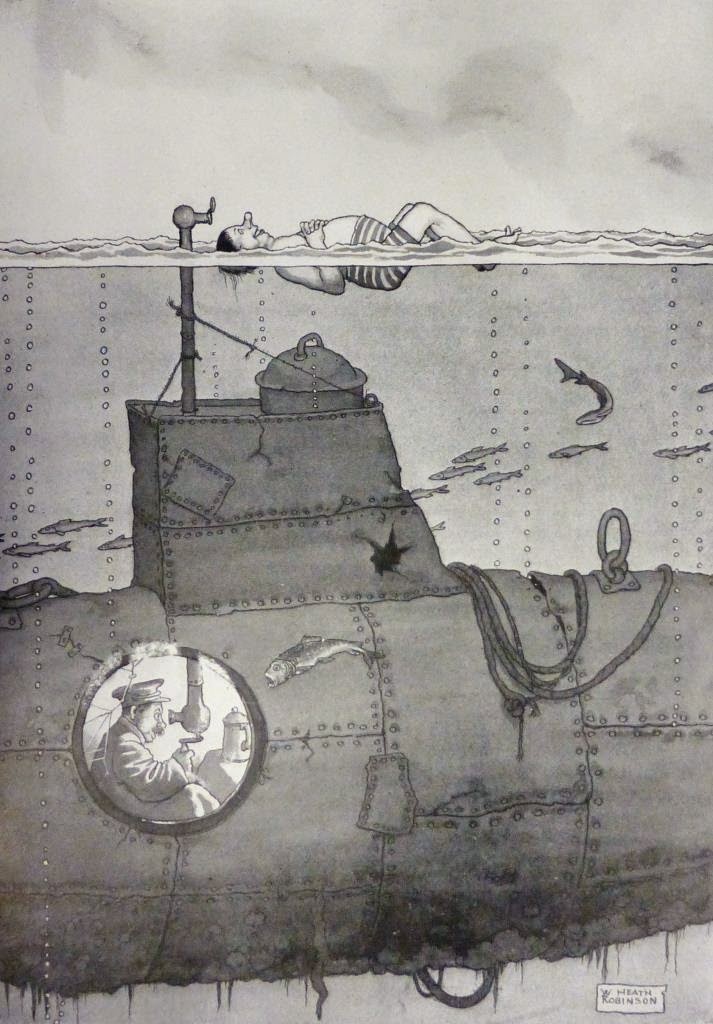
The caption shows a German Periscoper exclaining: "Ach, Himmel! Dot most be der peautiful Ben Nevis of vich ve 'ave 'eard so mooch!"

From the 1915 edition of Frightful War Pictures by W. Heath Robinson published by  Duckworth 

German periscopes were probably 'spotted' as frequently as suspected enemy spies. At least for cartoonists like Heath Robinson they could be a source of humour.  

‘The Great War at Fairlynch’ 2015 exhibition at Budleigh Salterton’s very special museum! Reviews included: “Wonderful display on WW1, informative, bright and relevant. Well done!!