Sir Hubert von
Herkomer: a self-portrait from around 1880
I’ve never been to Bushey, in Hertfordshire. Unlike
the peaceful coastal town of Budleigh Salterton
it seems to be very much a domitory place for commuters to London, with a population some five times
bigger than ours.
But in the late 19th century it was “a sleepy,
picturesque place” as one of its most famous former residents recalled. “It had
no water laid on, and there was no sanitation except of the most primitive
kind. The drinking-water was brought to the houses in buckets, for which the
old people, who carried it round, charged a halfpenny a bucket. The one and
only well from which they could obtain this drinking-water was situated quite
near the churchyard, a rather doubtful proximity, according to our modern
ideas. There was of course the usual well attached to each house for collecting
rain-water, which I remember was considerably stocked with live matter.”
The famous former resident was the Victorian painter
Sir Hubert von Herkomer, who chose to move to Bushey with his family in 1873.
The only connection between him and Budleigh Salterton is that he died here in
our town, 100 years ago today. Like another famous Victorian, the author Sir
Henry Rider Haggard, he came to Budleigh for its peaceful atmosphere and
healthy climate. Too late. His relatively short life came to an end when he was
only 65. He died in a house on the town's Marine Parade, known at the time as Matford.
But what a full life!
Not just a painter but a pioneering film-maker, composer, author and
enthusiast for modern technology. He sponsored an automobile race in Bavaria, the
Herkmerkonkurrenz from 1905 to 1907, and experimented with new forms of stage
lighting. A prominent member of the
Royal Academy of Arts, the Royal Watercolour Society and the Royal Society of
Painter-Etchers, he was admired by Vincent Van Gogh, ranked with artists like
Sir John Millais and was a friend of the art critic John Ruskin.
It was Ruskin who recommended him as Slade Professor
of Art at Oxford University, a post that he held from
1885 to 1894. The Herkomer Art School,
which he founded in Bushey in 1883 taught students from countries as far flung
as Sweden, South Africa, America,
and Australia.
He was honoured by King Ludwig of Bavaria and
Kaiser Wilhelm II of Germany,
and knighted by King Edward VII in 1907.
I enjoyed discovering the two volumes of his highly readable memoirs: you can find them
online at https://archive.org/details/herkomers01herkuoft

Portrait of
Lord Tennyson Chalk drawing 1879
In these volumes you can see portraits by Herkomer of
famous people of the time such as the poet Lord Tennyson. These commissions brought him considerable
wealth.

A Spinning
Party in the Bavarian Alps
Drawn facsimile on the block for the Illustrated London News 1878
You’ll also find examples of his sympathetic depiction
of the sufferings of the poor, inspired
by the harsh conditions that he experienced during his own childhood.
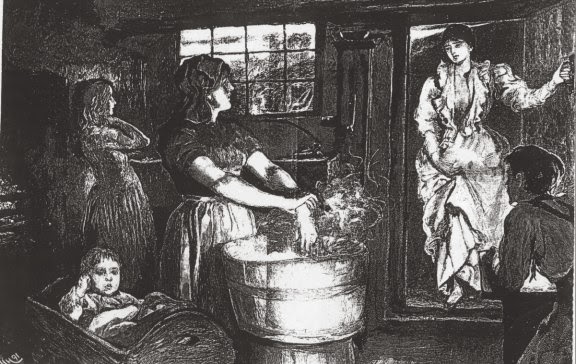
"There stood her mother, amid the group
of children, hanging over the washing tub." by Hubert von Herkomer, RA.
This plate, the first in the illustrated serialisation of Thomas Hardy's Tess
of the Durbervilles, appeared in the 4 July 1891 issue of the London Graphic. Scanned image and text
by Philip V. Allingham.
His illustrations of the impoverished workers of the
countryside were used in the Wessex
novels of Thomas Hardy, as seen above.
Herkomer reveals in his memoirs a deep affection for Britain and its
artists, although he notes with disapproval “how deep-seated are the
puritanical tendencies of the English race.” However his passionate love of the
countryside is unequivocal. Here, for example he goes into rhapsodies about the
time that he spent in Somerset.
“What a country for the artist!” he exclaims. “If ever
decay and neglect enhanced nature for
the painter's art, there it is in all
its artistry. The rich red soil, the undulating country, the apple-trees
tumbling about in their eccentric untouched shapes (untouched by man, except to
gather the fruit for cider making), the
dilapidated farmsteads; all a treasure ground for painter and poet. In spring, the first budding of
leafage, like jewels set in the deep purple
tonality given by the massing of tree branches not yet in leaf; the
offset of the strong green masses of ivy growths that have taken
overwhelming possession of the stems to
which they are attached, give a witchery to this corner of England unsurpassed,
I should say, in any part of the world.”
Maybe he should
have settled in East Devon.
He would have made a valuable Patron of the Council
for the Protection of Rural England, detesting as he did the rash of new
buildings spreading across the countryside. “The myriads of small dwellings
that are springing up on every available bit of land throughout this country,
built by small and large builders, by retired tradesmen, even by frugal workmen
(they do exist) who have saved a little money, poison this fair England of ours
like a black plague. The origin of this satanic scourge was made clear to me
when a builder showed a friend of mine a new street that he had perpetrated,
and exclaimed: ‘There! that is what I call a beautiful sight, all the houses
alike, and all let!’”
Equal in the intensity of Herkomer’s love of the
English countryside was his attachment to Bavaria, where he was born. Later in life he
discovered the beauty of his native landscape, which became a source of
inspiration for much of his work. His parents had emigrated to the USA in 1851
when Hubert was only three years old, settling briefly in Cleveland, Ohio,
before moving to Southampton, in England.
Art studies in London followed and in
1869 he exhibited for the first time at the Royal Academy.

His 1875 oil painting, ‘The Last Muster’ established his position as an artist of high
distinction at the Academy. It was
painted after Herkomer had attended a service at the chapel of the Royal Hospital,
Chelsea, the
home for veteran soldiers known as the ‘Chelsea Pensioners’. “The idea was to make every man tell some
different story, to be told by his face, or by the selection of attitude,”
Herkomer wrote. The central figure has slumped forward, his stick slipping from
his grasp. The old soldier beside him reaches for his pulse to discover that
his neighbour has indeed answered the call for ‘the last muster.’

Part of the
front elevation of Lululaund, Bushey
Herkomer’s love of Bavarian art and craft was
demonstrated in Lululaund, the substantial house built between 1886 and1894 in
the centre of Bushey and named after his second wife who had died shortly after
their marriage. Herkomer engaged the
eminent American architect H. H. Richardson for the project, and the house, described as ‘an Arts and Crafts
fairlytale home’, may be considered his only European work.

The
drawing-room at Lululaund
Much of the construction of Lululaund and the detailed
design, was the work of Herkomer himself. The stone was finished in his
workshops, and the interiors fitted out with materials worked by his
family.
For Herkomer, the question of his rights as a British
subject or as a German citizen was of less relevance than his life as an
artist. “What mattered to me these technicalities of nationality?” he wrote in
1910. “I am”, he explained, “a British subject wherever the British flag flies,
and a German subject wherever the German colours are hoisted. My case is
curious, but by no means without precedent”
But xenophobia was on the rise in the 19th century.
Herkomer’s father had evidently experienced it after settling in England, where he found that there was “but
little less prejudice against foreigners than in America.”
Hubert himself suffered from it during his time in Southampton. “Even I, as a boy, was under this bane of
prejudice,” he recalled in his memoirs. “I well remember a horse-dealer and
jobmaster - whose stables were at the end of the street - who never failed when
he met me to call me such names as ‘Dutchman’, ‘Foreigner’, ‘Roman Catholic’,
‘Brigand’, ‘Vagabond’, ‘Half-caste,’ etc.”
The early 20th century saw a worsening of such
prejudices. Ironically, in view of the
success of Herkomer’s ‘Last Muster’ as a work appealing to the public taste for
patriotic sentiment, his star declined because of this. It’s been said that despite being a prominent
member of London art societies, as well as being
on familiar terms with the royal family, he was never totally accepted by the
British establishment, and was ultimately a victim of the deteriorating
relationship between Great Britain
and Germany.

Many blame the deterioration on the influence of the
press. One journalist in particular led the way in portraying Germany as a threat to Britain. As
early as 1894 Alfred Harmsworth, proprietor of the Daily Mail, had commissioned
author William Le Queux to write The Great War in England, which featured
Germany, France and Russia combining forces to crush Britain. "This is the book that frightened the
life out of many British people, proclaiming a German threat a decade ahead of
the First World War," writes historian Max Hastings.
Twelve years later, with Harmsworth’s support, the exercise was repeated, resulting in the publication of the best
selling The Invasion of 1910. The book originally appeared in serial form in the
Daily Mail in 1906. Well before its appearance in the newspaper the public had
been fed a diet of thrillers in the same vein.
Some, like George Tomkyns
Chesney’s The Battle of Dorking (1871) or H.G. Wells’ The War in the Air (1907)
depicted a country invaded by a well organised enemy; others, like Erskine
Childers’ The Riddle of the Sands (1903) portrayed evil German spies involved
in sinister plans to destroy Britain.
“Next to the Kaiser, Lord Northcliffe has done more
than any living man to bring about the war,” wrote A.G. Gardiner, editor of The
Star newspaper.
By contrast, there were many like Herkomer, who loved Britain and Germany with an equal passion or
had Anglo-German families.
I can’t help thinking that their anguish, as they saw
the two countries drifting towards the 1914-18 world conflict, must have almost
matched that of those whose loved ones died in it.
The creator of ‘The Last Muster’ seems in any case to
have had had an almost prophetic view of how the appalling Great War would develop,
judging by the description in his memoirs of the Crimean campaign: “a bitter
and almost useless struggle, in a climate that vied with shot and shell to
decimate the ‘imperfectly organized and badly equipped’ allied armies at Alma,
Inkerman, and Balaklava.”

All that
remains of Lululaund Photo credit:
Bazj (2009)
Perhaps it was better that this fine artist, of whom I
knew nothing before writing this piece, did not live to witness the outbreak of
hostilities. Had he in fact lived until the Second World War he would have been
heartbroken to see what happened to his dream house of Lululaund. The house, which stood on Bushey's Melbourne Road, fell into disrepair in the 1920s, was
transferred to the ownership of Bushey Urban District Council and finally was demolished
in 1939. It’s widely reported that anti-German feeling may have played a part
in an ignorant Council’s action. All
that survives is the Grade II* listed base of the entrance porch and a section
of flanking wall, part of the entrance to the former British Legion Hall in
Bushey. The Hall is being redeveloped as housing. There’s a certain irony
there, I feel.
However I’m pleased to see that Bushey has been
twinned with the German town of Landsberg am
Lech in Bavaria, where there is a Herkomer Museum.
The Hertfordshire town now has a Herkomer Road, and Bushey Museum
itself has a Herkomer Room. It’s a volunteer-run museum, and admission is free.
Just like Fairlynch.
A talk about Herkomer was given by Museum volunteer Hugh Lewis on 18 March, serving as a prelude to a series of exhibitions during 2014-15.
Ten years ago, the Museum acquired a 1902 photograph album
belonging to Herkomer. Because of its size and condition it has not until now
been put on display. As part of the Museum's commemoration of Herkomer's
centenary, the album, together with enlargements of the photos, is on display
in the Jubilee Room.
The album records a visit by Herkomer, his wife
Margaret and their son Lawrence to Waal in Bavaria where the artist was born. The
occasion was the erection of a memorial to the fallen in the 1870/71
Franco-Prussian war, which he had designed. Herkomer was welcomed as a civic
celebrity, with town band, speeches, songs and bouquets. The family then went
on to nearby Landsberg, where, in honour of his mother, Herkomer had built a
tower which they used as a summer home. He included some watercolours of the
town in his album.
The Herkomer 1902 Photo Album Exhibition runs until 29
June 2014. Then from April 26 to September 7, an exhibition in the Art Gallery will be of drawings by Herkomer
and students of the Herkomer Art School.
This will be followed, in the Council Chamber from June 29 to January
11, 2015, by the Museum’s main Herkomer Centenary Exhibition, consisting of
Herkomer paintings, memorabilia and so on.
Finally, from September 13 to January 11, 2015, the Art Gallery and the
Herkomer Room together will display items from Lululaund.
For more information about Bushey Museum
click on http://www.busheymuseum.org